Lahbab Red Dunes —
Dubai’s red desert, explained.
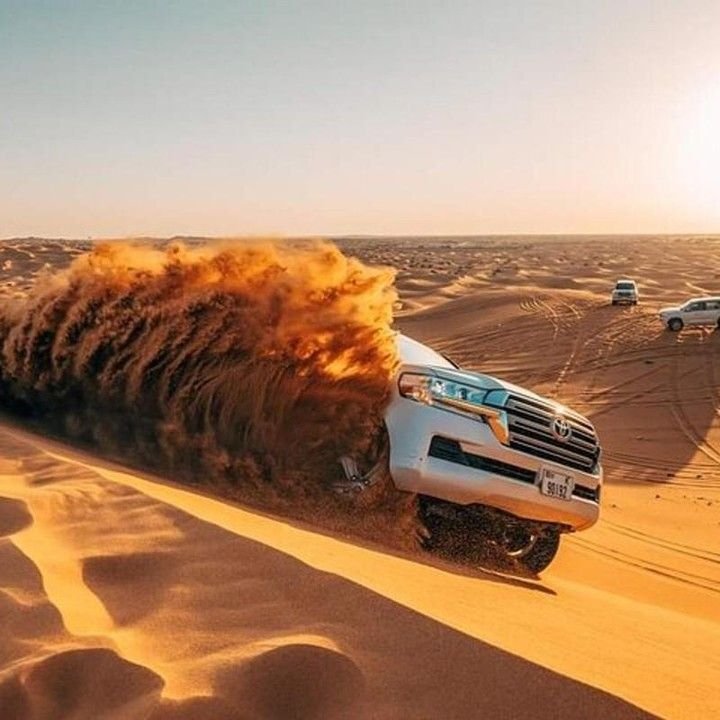
The Lahbab red dunes are Dubai’s signature desert — the tall, rust-coloured sand sea forty-five minutes east of the city where nearly every serious safari, including all of ours, actually happens. This is the complete guide to the place itself: where it is and how to reach it, why the sand is red when most of Dubai’s is grey, the landmarks from Big Red to the camel farms, what lives here, who lived here first, and every way to experience it from AED 35 upward. Consider this the dunes’ own home page.
Dubai desert safari prices at a glance
Self-drive AED 35 · shared bus AED 50 · shared 4×4 AED 120 · private 4×4 AED 600 for up to 6. Every option includes dune bashing, a camel ride, sandboarding, the BBQ dinner and live shows. Compare every Dubai package, or build your safari below and send it on WhatsApp — pay on arrival.
Build Your Safari
Book in under 2 minutes — pay on arrival
Choose your package, tell us where to pick you up, and confirm on WhatsApp. No card, no deposit — your seats are held instantly.
Step 1 — Choose your package
Step 2 — Number of guests
Step 3 — Add-ons (optional)
Step 4 — Your details
You will drive to our Al Awir Road desert meeting point — free parking, GPS pin sent after booking.
Where Lahbab actually is — geography, access and the lie of the red land
Lahbab sits along the E44 Dubai–Hatta road, roughly 45 minutes from Downtown and 35 from Sharjah — a broad band of high red dunes straddling the Dubai–Sharjah desert border, anchored by the small settlement of Al Lahbab (its mosque, petrol stations and famously well-provisioned roadside cafeterias serving the weekend 4×4 pilgrimage). The dune field runs south toward Al Marmoom’s conservation flats and east toward the Hajar foothills, with the tallest formations — the guest-name-worthy giants — clustered within a few kilometres of the highway.
Getting there is disarmingly simple: the E44 is a dual carriageway the whole way, our Al Awir Road meeting point sits on its city end with free tarmac parking, and every safari pickup route in this cluster funnels to the same desert gate. Self-drivers follow one road and one Google pin; everyone else follows the confirmation thread. The sand itself begins abruptly — Dubai’s grey urban desert yields to the red field across a boundary sharp enough to photograph, and the reason for that line is the geology section below.
The orientation worth having: the camps (ours among them) occupy licensed sites on the field’s western edge; the convoy routes work the big-dune interior; Big Red — Al Hamar — rises beside the highway twenty minutes further east as the field’s public monument; and the whole system is close enough to the city that its golden hour and Downtown’s rush hour occur simultaneously, forty-five minutes and a full world apart.
The red sand explained — iron, age and the boundary line
Dubai’s coastal sands are pale grey-beige — young, carbonate-rich, blown inland from the Gulf’s seabed. Lahbab’s are rust-red for one mineralogical reason: age. These are old continental quartz sands, and across millennia each grain has acquired a microscopic rind of iron oxide — literal rust — deposited by humidity cycles and baked on by several thousand summers. The deeper the red, the older the surface; the field’s crimson ridge lines are its senior citizens, and the pale bowls between them are newer arrivals still earning their coat.
The boundary line that startles first-time visitors — grey desert becoming red mid-horizon — marks where the coastal carbonate supply gives out and the old inland quartz body begins, a transition sharp enough that the E44 crosses it in a few hundred metres. It is the same geology that paints the Australian outback and Wadi Rum, expressed here within commuting distance of a metro system — the accessibility freak-of-nature this whole cluster is built on.
Why the colour performs at golden hour: iron oxide reflects long-wavelength light preferentially, so the low sun’s red-shifted spectrum meets a surface already tuned to amplify it — the dunes do not merely catch sunset, they resonate with it. Photographers call the effect saturation for free; the geology calls it a five-thousand-year paint job; and every ridge photograph on this site is the two descriptions agreeing.
Lahbab’s landmarks — Big Red, the camel farms and the field’s fixed points
Big Red (Al Hamar) is the field’s celebrity: a ninety-odd-metre star dune beside the E44 whose steep public face has served as the emirate’s informal hill-climb arena for decades — weekend crowds of private 4×4s, bike rental yards at its base, and a summit view across the whole red system for anyone willing to earn it on foot. Our private-safari guests can request the detour; everyone else photographs it from the highway with the reliability of a national monument.
The camel farms string along the field’s fringes — working Bedouin-family operations whose herds free-range the dunes at dawn and dusk, providing every convoy’s unscheduled wildlife moment and the morning safari’s commuting-camels spectacle. Al Marmoom’s conservation reserve and camel-race track border the field’s southwest — the race mornings documented on our camel page — while the Lahbab cafeterias on the E44 constitute a genuine cultural institution: karak tea, chapati wraps and a car park of sand-dusted Land Cruisers that functions as the desert scene’s clubhouse.
The working landmarks complete the map: the licensed camp cluster on the western edge (lantern-lit after dark and visible from the ridge lines), the deflation stops where every convoy airs down, and the compressor stations where they re-inflate — infrastructure invisible to guests and load-bearing for the entire industry. Lahbab is not wilderness; it is a managed desert commons with a working geography, and knowing its fixed points converts a safari from a ride through scenery into a visit to a place.
What lives at Lahbab — the field’s own species list
The red field runs its own ecology, adapted to the quartz body’s particular economy. The flora anchors it: ghaf trees — the UAE’s national tree, deep-rooted enough to drink the aquifer — dot the interdune flats and shade the field’s informal picnic culture; calligonum shrubs stitch the dune shoulders; and the post-rain weeks paint the bowls with ephemeral grasses that camels treat as a festival buffet.
The fauna reads like the morning page’s dawn census localised: Arabian gazelle on the Marmoom-side flats, red fox and Gordon’s wildcat working the night shift, dhub lizards sunning on the firm shoulders, sand skinks “swimming” the slip faces, and a raptor layer — kestrels, the occasional pharaoh eagle-owl — patrolling the rodent economy below. The camel herds, technically livestock, function ecologically as the field’s gardeners, pruning the calligonum and fertilising the ghaf flats on their dawn circuits.
The etiquette the ecology asks: the convoy routes exist partly to concentrate traffic away from the ghaf nurseries and gazelle flats — the leave-no-trace culture from our dune bashing guide is conservation policy wearing driving manners. Guests who want the naturalist’s version should book the morning slot, bring the zoom lens, and ask the driver for the wildlife line; the field rewards the request more often than the brochure dares promise.
Who Lahbab belongs to — Bedouin roots, the weekend scene and the safari economy
Before the E44 was a road it was a camel route, and Lahbab’s human story runs in three overlapping layers. The Bedouin layer persists in the camel farms, the family names on the area’s land, and the majlis-and-gahwa culture the camps package for visitors — the hospitality codes documented on our VIP page were rehearsed on this exact sand for centuries before tourism arrived to appreciate them.
The weekend layer is the Emirates’ own love affair: every winter Friday the field fills with private convoys — families with firewood and rugs, tuning-club Land Cruisers running the bowls, teenagers inheriting deflation technique from fathers — a genuine folk motorsport culture of which the safari industry is the commercial cousin. The Lahbab cafeterias’ car parks on those mornings are the scene’s parliament, and respectful visitors are welcome observers.
The safari layer — ours — professionalised the weekend culture for guests: licensed camps, certified drivers, insured convoys and the price list this cluster publishes. The three layers coexist by etiquette (the convoy law from the dune bashing page is the field’s constitution), and the visitor’s benefit is a desert that feels alive rather than staged — the camels commute, the locals barbecue, the tuning club crests a ridge in formation, and your safari threads through a working landscape that never once performs for you. That authenticity, unbookable elsewhere at any price, is Lahbab’s quiet monopoly.
Every way to experience Lahbab — the complete access table
| Route in | Cost | What you get | Best for |
|---|---|---|---|
| Any safari on this site | From AED 35 | The dunes, camp, dinner and shows — the full managed experience | Everyone’s first answer |
| Self-drive to Al Awir + safari | AED 35 | Your car to the gate, ours on the sand | Budget independence |
| Big Red public face | Free (rentals extra) | The monument dune, weekend crowds, bike yards | A taste without a booking |
| Private safari with Big Red detour | AED 600/vehicle | The field’s highlights on your itinerary | Photographers, repeaters |
| Al Marmoom race mornings | Free (winter) | Camel racing at the field’s edge | The camel-converted |
| Own 4×4, weekend scene | Fuel + skills | The folk version — deflation, bowls, cafeteria karak | Experienced desert drivers only |
The table’s honest gradient runs from zero-effort to expert-only, and the field accommodates the entire span nightly. The one universal: everyone airs down, everyone waves at stuck strangers, and everyone ends up at golden hour facing the same direction — Lahbab’s real admission fee is participation in its manners, and this cluster’s sixteen pages are essentially an etiquette guide with prices attached.
Photographing the red dunes — a working manual
Golden hour on iron-oxide sand — the Lahbab glow
Lahbab is arguably the most photographed patch of sand in the Emirates, yet most visitors come home with flat, orange-grey frames that look nothing like the postcards. The gap is not equipment — phone cameras handle the desert fine — it is timing and position, and both are learnable in five minutes. The iron-oxide coating that makes the sand red reflects most strongly in the red-orange band of the spectrum, which means the dunes respond to light quality more dramatically than almost any landscape you have shot. At noon, with white overhead light, the field reads as a washed-out apricot. In the final ninety minutes before sunset the same sand cycles through amber, copper and finally a deep rust that needs no filter. Photographers call it the Lahbab glow; physicists call it selective reflectance; our drivers call it the reason every evening safari is timed the way it is.
Composition — shoot across the light, not with it
Position matters as much as hour. Shoot with the sun behind your shoulder and the dune faces flatten; shoot across the light — sun at ninety degrees to your lens — and every ripple in the sand casts its own millimetre of shadow, turning the slip faces into corduroy. The classic Lahbab frame is a ridgeline running diagonally through the shot, wind-sculpted texture in the foreground, one human figure or camel silhouette for scale. Your safari driver knows the two or three bowls where this composition assembles itself; ask him to pause at the sunset stop rather than shooting from the camp gate, where forty other phones share your angle.
Phone settings that work
Drop exposure a third to half a stop — auto meters overbrighten sand and kill the red. Lock focus on the ridgeline, not the sky. Burst mode for dune-bash action shots through the window; the vehicle vibrates too much for single frames.
Camera & lens notes
A 70–200mm compresses distant ridgelines into stacked layers — the signature big-desert look. Wide angles need a strong foreground: ripples, a calligonum bush, footprints. Change lenses inside the vehicle; airborne quartz dust is a sensor’s enemy.
Drone rules — read first
UAE drone law requires GCAA registration and flying only in approved zones — much of the Lahbab area sits near flight paths and camel farms where drones spook stock. Fines are severe. Ask before you fly; our team will tell you honestly whether your permit covers the spot.
Best month for red-dune photography
The month changes the palette too. Winter air (December–February) is at its clearest after the occasional rain, which also darkens and saturates the sand — the two or three days after a shower are the reddest of the year. Summer haze mutes contrast but produces enormous soft-orange sunsets that flatter portraits. If your one goal is the deepest red possible, book the evening slot in January and pray for rain two days before; if your goal is people looking good against the dunes, any golden hour will do, and the professional-photographer add-on (from AED 50) exists precisely for guests who would rather be in the frame than behind it.
Reading the dunes like a driver — safety, seasons and sand-craft
How sand behaves — morning grip vs afternoon float
Every safari driver who works Lahbab carries an informal syllabus in his head: which bowls hold soft sand after wind, which ridgelines are safe to crest blind, where the recovery convoys stage on busy Fridays. Guests never need this knowledge — that is what the driver is for — but understanding a little of it turns the dune bash from a fairground ride into something you can actually read. Sand behaves differently through the day. Overnight humidity firms the surface, which is why morning drives feel faster and grippier; by mid-afternoon the top layer dries loose and vehicles float and slide more, which is why the evening bash feels wilder at identical speeds. Wind rebuilds the dunes constantly — after a strong shamal the drivers effectively relearn the field, because slip faces have moved metres overnight.
DTCM safety rules on the Lahbab dunes
The safety architecture around all this is stricter than most guests assume. Dubai’s DTCM licensing regime requires desert drivers to hold a specific dune permit renewed with practical testing, vehicles to carry roll cages, first-aid kits and functioning radios, and operators to run convoys rather than lone vehicles on the deep-desert routes. Tyre deflation to roughly 15 psi is not a trick for fun — it lengthens the tyre’s footprint so the vehicle floats instead of digging, and it is the single practice that separates professionals from the weekend crowd waiting for recovery beside the E44. Seatbelts stay on for every second of the bash; pregnant guests and children under three ride the flat routes or wait the bash out at camp with a karak in hand.
| Season at Lahbab | Daytime feel | What the field is like | Best slot |
|---|---|---|---|
| Nov–Feb | 22–28°C, cool nights to 10°C | Firm sand, clearest air, post-rain deep reds, peak season crowds | Any — overnight shines |
| Mar–Apr | 28–35°C | Warming fast, occasional shamal winds re-sculpt dunes, wildflower flush after rain | Morning or evening |
| May–Sep | 38–45°C | Loose floaty sand, big hazy sunsets, empty field, camps run misting fans | Evening only (or dawn) |
| Oct | 30–36°C | The turn — humidity drops, drivers celebrate, bookings climb weekly | Evening |
Desert etiquette — two rules that matter
Two field courtesies keep the place working for everyone. First: rubbish leaves with you, always — the camps run bins, the dunes do not, and a single plastic bag can end up in a gazelle. Second: the camel farms along the fringe are working businesses, not petting zoos; photograph from the track, keep the drone grounded, and if a herder waves you in for a closer look, that is Lahbab hospitality operating exactly as it has for generations — accept the karak.
Lahbab versus the UAE’s other deserts — an honest comparison
Lahbab vs Liwa vs Al Marmoom — which desert for what
The Emirates is essentially one connected sand sea with several famous doorways, and travellers regularly ask us whether Lahbab is “the best” desert or merely the closest one to Dubai. The honest answer is that each field has a personality, and Lahbab’s happens to suit the classic safari better than any of its rivals. Al Khatim, the Abu Dhabi field where our sister operation runs, shares the same iron-oxide geology and nearly identical dune scale — if you are based in Abu Dhabi, go there and lose nothing.
The Liwa crescent on the Saudi border is the heavyweight: dunes over 200 metres, genuinely remote, the setting of Star Wars and Dune shoots — but it is a three-hour drive from Dubai and its scale demands full-day or multi-day expeditions, not an evening out. The Al Qudra and Al Marmoom flats south of Dubai are beautiful for cycling and flamingo lakes but the dunes are low and pale — lovely for a picnic, underwhelming for a bash.
Lahbab — the all-rounder
45 minutes from Downtown, dunes big enough to thrill, red enough to photograph, with the UAE’s densest camp infrastructure. The reason 90% of Dubai safaris happen here.
Liwa — the expedition
Mega-dunes and true remoteness, three hours away. Worth a dedicated overnight trip for desert obsessives — not a substitute for an evening safari.
Al Marmoom — the reserve
Protected conservation flats with oryx and lakes on Lahbab’s south-western edge. Sunrise cycling and birdwatching, not dune bashing — the two complement rather than compete.
Lahbab, Lehbab or Al Lahbab? The spelling question settled
There is also the name question, which deserves a proper answer because half the internet spells it differently. Al Lahbab, Lehbab, Lihbab and “the red dunes Dubai” all describe the same place — transliteration from Arabic has no single correct form, and road signs on the E44 themselves vary. Locals shorten the whole area to “Big Red” after its landmark dune, the way Londoners say “the Eye” for the wheel. Whatever spelling your search engine prefers, the coordinates do not move: the high red field either side of the Dubai–Hatta road, roughly between the Al Awir fringe and the Sharjah border, is where this entire website’s Dubai operation lives and where every package on it will take you.
No gates, no tickets — how access to Lahbab really works
One last piece of context worth having before you book: Lahbab is not a gated attraction, and that is precisely its charm. There is no ticket office, no opening hours, no turnstile — the desert simply begins where the tarmac ends. What the safari industry adds is access with competence: deflated tyres, licensed drivers, camps with plumbing, and someone who knows which bowl catches the last light. You can stand at the foot of Big Red for free this afternoon; you can also be on a high ridgeline at golden hour with a falcon on your arm and dinner waiting below for AED 50. The dunes hold both experiences without contradiction, which is exactly what this page has tried to show.
Lahbab at night — the desert the day visitors never meet
Stars over Big Red — the overnight sky
Most guests leave Lahbab as the camp lights come up, which means most guests never meet the desert’s second act. Forty-five kilometres of sand between you and the city buys perhaps two full magnitudes of sky darkness over Downtown — not observatory-grade, but enough that the Milky Way’s core rises visibly over the southern dunes on moonless summer nights, enough that Orion in winter hangs sharp over Big Red the way it hung over Bedouin camps for centuries when those same stars were the navigation system. Overnight guests (AED 450, minimum two) get the whole show: the camp generators cut, the temperature slides ten degrees, and the field goes silent in a way that city dwellers physically feel — engineers have measured desert night ambience below 20 decibels, quieter than a library, quiet enough to hear your own pulse.
The dawn ledger — wildlife tracks at first light
The nocturnal shift changes crew too. The gazelle and fox you might glimpse at dusk become active in earnest; gerbils stitch tracks between the calligonum bushes; owls work the camel farms’ floodlit fringes for the rodents the lights attract. By first light — and the sunrise over the red field is, dune for dune, the equal of the famous sunset with a tenth of the audience — the sand records the whole night’s traffic in prints, a fresh page that the wind will wipe by noon. If any single experience on this site converts sceptics into desert people, it is waking up inside Lahbab.
The caravan road — Lahbab before the safaris
And a final note on the name you have been reading for five thousand words. Lahbab began as a waypoint — a cluster of wells and camel grazing where the Dubai–Hatta caravan route crossed the high sand. The settlement of Al Lahbab still stands, its residents still keep camels, and the E44 that brings you to your safari follows, in essence, the same line the caravans walked.
The safari industry did not invent this place; it plugged into a corridor that has moved people across the red sand for as long as anyone has kept records. When your Land Cruiser drops onto the first slip face tonight, you are the newest entry in a very old ledger — and whether you arrive by AED 35 self-drive, AED 50 bus, or AED 600 private 4×4, the dunes charge everyone the same nothing and give everyone the same everything. One WhatsApp message is the distance between reading about Lahbab and standing on it.
Lahbab at a glance — the numbers travellers ask for
For the planners and the fact-checkers, here is the whole page condensed into one paragraph of verifiable figures. Distance from Downtown Dubai: roughly 45 kilometres, 40–50 minutes by road along the E44. Distance from Sharjah city: about 35 minutes. Height of Big Red (Al Hamar): approximately 90 metres of climbable red sand, free to visit at its public face. Typical dune heights across the wider field: 20 to 60 metres. Why the sand is red: iron-oxide coating on ancient inland quartz grains — the older the sand, the deeper the rust. Cheapest legitimate way onto the dunes: our AED 35 self-drive safari, meeting at the Al Awir fringe.
Most complete way: the overnight camp at AED 450 with the star field and sunrise included. Resident wildlife you might actually see: Arabian gazelle, red fox, dhub lizard, desert larks, and the free-ranging camels of the fringe farms. Governing safety regime: DTCM licensing with mandatory dune permits, roll cages and convoy protocols. Number of alternative spellings that all mean this exact place: at least four — Lahbab, Al Lahbab, Lehbab, Lihbab. Number of Dubai desert safaris on this website that happen anywhere else: zero. Everything above this paragraph is the long version; everything below it, in the FAQs, is the short one; and the WhatsApp button is the shortest of all.
Where to go next on this site
Postscript for the cross-referencers: this location guide pairs naturally with three other pages on the site. The sunrise safari page covers the dawn experience these dunes host at their emptiest; the timings guide translates Lahbab’s seasonal rhythms into concrete pickup schedules; and the dune bashing page dissects the driving craft that the sand-craft section above only sketches. Between the four of them you can arrive at the red dunes knowing more about the place than many of the people paid to drive across it — which is, frankly, the standard this website is trying to set. The desert rewards the curious: guests who know why the sand is red watch the golden hour differently, guests who know the gazelle are crepuscular scan the calligonum shadows on the ride in, and guests who know Big Red’s height argue about it cheerfully at the summit.
Bring the curiosity; Lahbab supplies everything else. And if you arrived here searching for a “red dune desert safari in Dubai” — that is not a separate product, it is simply the accurate name for every safari on this site: all of them run on these red dunes, from the AED 35 self-drive to the private night convoys, because Lahbab IS Dubai’s red dune desert. And if a question about the red dunes survives all five thousand words above — a spelling, a coordinate, whether Big Red is climbable in August, whether the camel farms mind visitors on Fridays — the WhatsApp line answers geography questions as happily as booking ones. Our drivers grew up reading this sand; asking them things is not an imposition, it is the best free upgrade the safari offers, and more than one guest has left with a hand-drawn map of the field on a camp napkin. The dunes have been collecting stories for four thousand years; yours starts with a message.
Lahbab red dunes — frequently asked questions
Along the E44 Dubai–Hatta road, about 45 minutes from Downtown Dubai and 35 from Sharjah — a high red-dune field straddling the Dubai–Sharjah desert border around the settlement of Al Lahbab. Every safari on this site runs here.
Iron oxide — each grain of the old inland quartz sand wears a microscopic rust coating built up over millennia. Dubai’s young grey coastal sands lack it, which is why the grey-to-red boundary is sharp enough to photograph from the E44.
The field’s landmark star dune — roughly 90 metres, beside the highway, the emirate’s informal hill-climb arena with bike-rental yards at its base. Free to visit; private-safari guests can request the detour.
Yes — Big Red’s public face and the E44 cafeterias need no booking, and experienced 4×4 owners join the weekend scene. But the dune interior, the camps and golden hour on the high ridges are the safari’s domain — from AED 35, per the access table above.
No — Al Khatim is Abu Dhabi’s equivalent field where our Abu Dhabi operation runs. Same geology family, different emirate; visit whichever matches where you sleep.
Arabian gazelle, red fox, dhub lizards, sand skinks, desert larks and raptors — plus the free-ranging camel herds of the fringe farms. The morning slot and a zoom lens serve the naturalist best.
Golden hour — iron oxide preferentially reflects the low sun’s red spectrum, so the field literally resonates with sunset. Post-rain days deepen the colour further; the geology section explains the physics.
Only a proper 4×4 with deflated tyres and desert experience — rental sedans end in recovery invoices, as the private page’s rental showdown documents. The AED 35 self-drive tier exists precisely so your car stays on tarmac while ours does the sand.
A cultural institution — karak tea, chapati wraps, and the weekend 4×4 scene’s clubhouse car park. Self-drivers pass them en route; ask your driver which one the convoy crews rate this season.
Any package on this site lands you here — one WhatsApp message, from AED 35 self-drive to the private and overnight tiers, pay on arrival. The dunes are the constant; the tier is your choice.
Ready for the dunes? Send us a message.
Pick your package above, or just tell us your date and guest count on WhatsApp — we’ll confirm your price, pickup time and meeting point within minutes.
💬 Book on WhatsApp — Pay on ArrivalTonight from AED 35, pay on arrival
No card, no deposit.