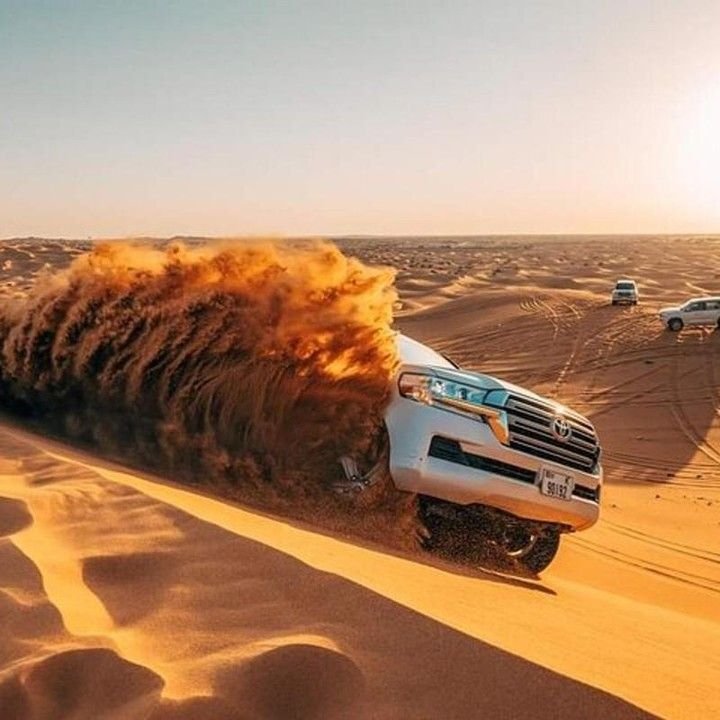
Sandboarding Dubai —
free with every safari.
Sandboarding in Dubai happens on the Lahbab red dunes — the steepest, smoothest boarding slopes within an hour of the city — and with us it is included free in every safari ticket, from the AED 35 self-drive evening upward. Unlimited runs, boards and wax provided, kids from five welcome. Operators selling “sandboarding tours” at AED 95–350 are selling you a safari with one activity highlighted; this page explains the whole sport honestly and how to get it for the price of the evening you were booking anyway.
Dubai desert safari prices at a glance
Self-drive AED 35 · shared bus AED 50 · shared 4×4 AED 120 · private 4×4 AED 600 for up to 6. Every option includes dune bashing, a camel ride, sandboarding, the BBQ dinner and live shows. Compare every Dubai package, or build your safari below and send it on WhatsApp — pay on arrival.
How to sandboard — the complete beginner’s technique, taught honestly
Sandboarding’s secret is that it is dramatically easier than it looks and slightly harder than the brochures admit. The learning curve is measured in runs, not days — most guests stand and ride by their third descent. Here is the actual technique, as taught at the camp slope every evening:
1 · Wax the base
Sand is slower than snow — friction is the enemy. Rub the wax block (provided) across the base before every second or third run. The difference between a waxed and unwaxed board is the difference between surfing and sledging through mud.
2 · Stance: lead foot forward
Front foot in the strap angled forward, back foot across the board, knees soft, weight centred-to-front. Beginners instinctively lean back — that is the guaranteed sit-down. Nose down the slope, eyes on the runout, not your feet.
3 · The first descent
Start seated if nervous — sledding the board teaches the speed feel with zero stakes. Standing: small hop to point the nose downhill, commit, and let the sand do the braking (it will — soft sand self-limits speed at roughly jogging pace on camp slopes).
4 · Turning (optional honesty)
Real carving on sand needs steeper faces and speed — on beginner slopes, gentle weight-shifts curve your line and that is genuinely enough. Nobody carves like the YouTube edits on their first evening; those are dawn sessions on Big Red with waxed pro boards.
5 · Falling correctly
You will, it is soft, and this is the sport’s great mercy: sand falls cost nothing but dignity and a shoe full of desert. Fall sideways-and-down, not backwards-uphill. Kids treat falling as the second activity; adults learn to.
6 · The climb back
The unadvertised workout: every run is earned by the walk up. Climb the firm windward shoulder, not the soft slip face; sidestep like a skier. This is why sandboarding sessions self-regulate — legs, not tickets, decide when you are done.
Sandboarding vs snowboarding — an honest translation for riders
| Sand (Lahbab) | Snow (for reference) | |
|---|---|---|
| Speed | Slower — soft sand self-brakes; steep faces get quick | Faster everywhere |
| Falls | Soft, warm, harmless — beginner paradise | Ice exists and holds grudges |
| Edge control | Minimal — weight shifts, not edges | The entire sport |
| Lifts | Your legs | Chairlifts |
| Gear | Board + wax, provided free | AED 300+ daily rental |
| Season | 365 days | Ski Dubai’s indoor slope, AED 240 |
| Learning curve | Riding by run three | Bruised by lesson three |
Snowboarders pick sand up instantly (dial the edge instinct down, everything else transfers). Total beginners should genuinely learn here first: the sand forgives everything the mountain punishes. And skiers asking about sand-skiing: yes, it exists; no, we do not stock skis; yes, the one guest who brought his own remains a camp legend.
Where you actually board — Lahbab’s slopes graded like a resort
Ski resorts grade runs; nobody grades dunes. Fixing that, from our camp’s nightly boarding sessions:
| Slope | Grade | Height / angle | Who rides it |
|---|---|---|---|
| The camp slope | 🟢 Green | ~10–15m, gentle | Everyone’s first runs; kids’ headquarters; unlimited laps included with every safari |
| The ridge shoulder (photo-stop dune) | 🔵 Blue | ~25–35m, moderate | Second-evening confidence; the drivers point out the best line at the sunset stop |
| Slip-face walls (on request) | 🔴 Red | ~40m+, 30°+ | Riders with technique — ask your driver; the convoy carries boards and the walls are five minutes from camp |
| Big Red (Al Hamar) | ⚫ Black | ~90m monster | The pilgrimage dune on the Hatta road — public access, weekend crowds, legs of steel required for the climb. Private-safari guests can request a Big Red detour |
The insider physics: slopes ride fastest in the morning when overnight moisture firms the surface — the same reason morning safaris suit serious boarders — and slowest at mid-afternoon fluff. Evening sessions split the difference and add the golden-hour backdrop that makes every wipeout cinematic.
Kids, cameras and the sandboarding evening in practice
Children own this activity. From age five they ride seated (sled-style) solo and standing with a hand from the camp team; the camp slope’s runout is flat, soft and thirty metres from your table. It is the safari’s only activity where kids genuinely outperform adults — lower centre of gravity, zero fear of soft landings, infinite climb energy — and the buffet afterwards has never been more earned. Parents’ only real job: the sand-out-of-shoes ceremony at the end, best performed before the car.
Filming it: the classic angle is from the bottom third of the slope, low, shooting up — the dune reads twice as steep and the sky does the production design. Phone slow-motion (240fps) turns a ten-second run into the group chat’s highlight; the sunset ridge session adds rim-light for free. GoPro chest mounts beat helmet mounts on sand (less shake, more board in frame); hand the camera around — the walking-up footage of everyone else is comedy gold that edits itself.
What to wear for boarding specifically: closed shoes or barefoot both work (evening sand is cool — barefoot is the local child’s choice), long shorts or leggings beat loose trousers on the sit-down runs, and sunglasses stay in the pocket for the descent — one tumble teaches this permanently. Everything shakes clean; sand is the world’s most temporary souvenir except from pockets, where it is eternal.
What people ask about sandboarding on Google, Reddit and Quora
| The question people actually type | The straight answer |
|---|---|
| “Is sandboarding in Dubai worth it?” | As a paid standalone tour at AED 95–350 — debatable. As an unlimited included activity inside a safari you were booking anyway — unquestionably. That pricing difference is the entire market trick this page exists to explain. |
| “Is sandboarding hard for beginners?” | It is the easiest board sport on Earth to start: soft falls, self-limiting speed, standing by run three. The hard part is the walk back up, which no operator advertises and every guest discovers. |
| “Can you sandboard in Dubai in summer?” | Yes — evening sessions after 17:00 and morning sessions before 10:00 run year-round. The sand surface in July midday reaches 70°C+; the sport does not exist at that hour, and neither should you. |
| “Sandboarding vs sand skiing vs sand sledding?” | Boarding (standing) and sledding (seated, same board) are both included and interchangeable run-to-run. Sand skiing exists as a niche sport with dedicated gear; Dubai’s camps, including ours, run boards only. |
| “Do I need to book sandboarding separately?” | Not with us — boards, wax and unlimited camp-slope runs are in every ticket from AED 35. Operators listing sandboarding as a separate AED 50–100 line item are unbundling what the desert includes by nature: a slope and gravity. |
Build Your Safari
Book in under 2 minutes — pay on arrival
Choose your package, tell us where to pick you up, and confirm on WhatsApp. No card, no deposit — your seats are held instantly.
Step 1 — Choose your package
Step 2 — Number of guests
Step 3 — Add-ons (optional)
Step 4 — Your details
You will drive to our Al Awir Road desert meeting point — free parking, GPS pin sent after booking.
Sandboarding’s story — from Pharaohs’ sleds to Peru’s world cups to Lahbab
Sandboarding is older than snowboarding and younger than its own legend. Egyptian hieroglyph enthusiasts claim pharaonic children slid Nile dunes on wooden planks; verifiable history starts more modestly in the 1970s, when Californian surfers and early snowboard tinkerers took their boards to the dunes between swells and seasons. The sport formalised in South America — Peru’s Cerro Blanco, a 1,176-metre monster near Nazca, remains sandboarding’s Everest, and Chile’s Atacama and Brazil’s Natal dunes host the closest thing the sport has to a world circuit. Germany, improbably, runs the annual world championship on a mining spoil-heap called Monte Kaolino, complete with a dune lift — the only one on Earth.
The Gulf’s contribution is accessibility. Nowhere else do serious, steep, rideable dunes sit thirty minutes from two million people and a metro system: Peru’s giants demand expeditions, Namibia’s Swakopmund dunes a dedicated holiday, but Lahbab is a Tuesday evening. When Dubai’s safari industry folded boards into the camp evening in the 2000s, it quietly created the world’s highest-volume sandboarding venue — thousands of first descents every single night, more new boarders annually than the sport’s formal federations have registered in their history.
The board itself tells the same story of adaptation: shorter and wider than a snowboard, base laminated with formica or melamine (snow bases grip sand like velcro), and waxed with paraffin before runs — the ritual you will perform at the camp slope, connecting your evening, whether you know it or not, to a Peruvian huarango-wood tradition and a German mining hill’s peculiar glory.
Why sand slides — the science your board is standing on
Every run down the camp slope is applied granular physics, and knowing it genuinely improves your riding. Dry sand grains lock together until the slope hits roughly 34 degrees — the angle of repose — at which point the surface layer flows like a liquid. A sandboard works by riding the boundary of that phase change: your weight and speed fluidise a thin layer of grains under the base, and you surf the miniature avalanche you are creating.
This is why wax matters so much: sand’s friction against an unwaxed base is triple snow’s. The paraffin fills the base’s micro-scratches so individual grains roll rather than drag — the difference is measurable and the camp’s wax block is not a suggestion. It is why morning sand runs faster: overnight humidity forms microscopic bridges between grains, firming the surface so your board floats higher and ploughs less. By afternoon the sun has dried the bonds and the top inch turns to powder that swallows momentum. And it is why the steep slip faces feel alive underfoot: at repose angle the dune is one footstep from flowing, and the soft whisper you hear descending is thousands of grain-collapses lubricating your line.
The desert’s last physics gift is acoustic: under the right humidity, large avalanching faces produce the famous “singing dune” hum — a deep resonance around 100Hz caused by synchronised grain shear. Lahbab sings rarely and briefly, but boarders on the big walls at the right dawn have heard it. Consider it the sport’s rarest achievement badge.
Three sandboarding session plans — first-timer, family and rider
The first-timer’s evening (any safari ticket): arrive at camp, claim a board before the dinner rush, and spend runs one and two seated to learn the speed. Runs three to six standing on the camp slope — this is where you cross from surviving to riding. Break for the camel and henna circuit while your legs regenerate, then take two sunset runs when the slope empties (everyone else is photographing the sky; the boarding queue drops to zero at exactly golden hour — the insider’s window). Total: eight to ten runs, one evening, zero extra dirhams.
The family session: stake the slope-side majlis table as base camp. Under-eights ride seated with a parent walking alongside the runout; eight-to-twelves go standing within three runs and then refuse to stop — the practical limit is dinner, not ability. The camp team hands out boards and encouragement in equal measure, and the slope’s flat runout means supervision is a deckchair activity. Pro parental move: schedule boarding before dinner; sandy children eat better and negotiate less.
The rider’s morning (for people who came to actually board): book the morning safari, request the boarding-focused stop on WhatsApp, and hit the ridge shoulders before 09:00 while the crust is fast. Bring your own board if you have one (welcome, and the drivers respect it instantly), wax hard, and ask the driver to point out the graded lines — the 30-metre slip faces ride like blue runs at that hour. Six big-wall descents with climbs is a genuine workout; the private 4×4 option turns it into a guided session with vehicle support between faces, which is as close to a dune lift as the sport gets outside Germany.
Lahbab vs the world’s famous sandboarding dunes — an honest scorecard
| Venue | Dune scale | Access | Season | Verdict for a traveller |
|---|---|---|---|---|
| Lahbab, Dubai | 10–90m (Big Red) | 30–45 min from a metro city; included in AED 35+ safaris | 365 days (mornings/evenings in summer) | The world’s most accessible real dune boarding — unbeatable effort-to-run ratio |
| Cerro Blanco, Peru | 1,176m — the planet’s giant | 3h from Nazca + 3h climb | Apr–Nov | The pilgrimage. One descent, one day, legend status |
| Swakopmund, Namibia | 100–300m | Dedicated trip; tour operators | Year-round, cold mornings | The sport’s spiritual home; lie-down speed runs hit 80 km/h |
| Huacachina, Peru | 50–150m | Oasis town, buggy-assisted laps | Year-round | Backpacker classic — buggies do the climbing |
| Monte Kaolino, Germany | 120m spoil-heap | Bavaria; has the world’s only dune lift | Summer | World championships and zero climbing — gloriously absurd |
| Little Sahara, Australia | ~70m | Kangaroo Island ferry + drive | Year-round | Beautiful, remote, seals nearby |
The honest reading: four of these venues demand a dedicated journey; one demands Bavaria. Lahbab asks for an evening you were already planning, throws in dinner and a fire show, and starts at AED 35. Board the giants someday; board Lahbab this week.
The Lahbab boarding almanac — month by month on the slopes
October reopens the full-day season: the first firm-crust mornings return, evening slopes hold shape past sunset, and the boarding queue is shortest of the peak months. November through February is prime time — cool sand all day, the fastest crusts of the year after humid nights, and the only period when midday boarding is genuinely pleasant; February’s occasional rain events produce the year’s fastest surfaces the following morning, a secret the regulars guard poorly. March and April stretch the season with warm perfection, the slip-face walls at their most forgiving as deeper moisture lingers.
May through September is schedule discipline: board before 09:30 or after 17:00, never between — the surface hits temperatures that end sessions through shoe soles. The compensation is emptiness: a July 08:00 session owns every line on the ridge, and the summer dawn crust, fed by Gulf humidity, is counterintuitively among the fastest of the year. September brings the transition — the first post-humidity crusts, the camps refilling, and the year’s best value window before peak pricing psychology returns to the market (ours, as established, does not move).
Wind reading for boarders: the shamal’s afternoon blows load the northeast faces with fresh soft sand (slow, deep, beginner-flattering) while stripping southwest faces to firm ribs (fast, technical). After any windy day, expect rebuilt ripples and a re-set slope — the dune you rode last week does not exactly exist anymore, which is either the sport’s frustration or its poetry depending on your run count.
Boards, bases and wax — the equipment guide nobody in Dubai publishes
The camp boards are the sport’s honest workhorses: laminated wood decks around 100–110cm, formica bases, single front strap, built to survive a thousand tourist descents a season. They are tuned for stability over speed — wide, flat-rockered, forgiving of the backseat lean every beginner brings — and they are the correct tool for ninety percent of the evening’s riders.
Enthusiast boards, if the sport bites you, split into two schools: Venomous-style composite decks with slick laminate bases (Peru/US school — fast, needs waxing discipline) and the lacquered wooden boards of the Namibian tradition. A serious sand deck runs USD 150–300; airlines treat them as snowboards. Base material is the entire purchase decision: melamine and formica slide; snowboard P-tex, counterintuitively, does not — its microstructure grips grains. Never bring a real snowboard to sand for this reason plus one more: sand voids every snow warranty on contact.
Wax doctrine: paraffin blocks (the camp’s and everyone’s) rubbed base-wide every second run; speed obsessives layer car-polish paste beneath paraffin for the big walls. There is no such thing as too waxed on sand. Strap and stance: one front strap suffices below 30 degrees; riders attacking slip faces add a rear strap for edge authority. Stance mirrors your snowboard or skateboard lead — and if you own neither, the camp team’s two-second test (which foot catches you when pushed) settles it permanently.
Maintenance in the sand economy: base scratches are sanded (fittingly) with fine grit and re-slicked; decks live long lives if kept out of car-boot ovens in summer. The camp handles all of this invisibly — but riders who fall for the sport tend to end up with a board in the hallway and opinions about formica, and this section exists to accelerate that fate.
Sand sledding, dune sports and everything else you can ride out here
The board is the headline, but Lahbab’s slopes host a whole quiet taxonomy of descent. Sand sledding — the same board ridden seated, or purpose sleds on bigger walls — is the underrated king of family sessions: zero learning curve, higher speeds than standing (lower centre of gravity, more base contact), and the activity of choice for every guest who came in a dress or left their knees in a previous decade. Grandparents sled; it is a camp tradition and the photographs are annually excellent.
Sand tobogganing runs on the steeper shoulders reach genuinely quick speeds — the camp team marks the season’s safe lines — and dune rolling, childhood’s original extreme sport, remains available to all ages at the price of one thoroughly sanded everything. On the technical end, a small scene of UAE riders runs sand skis (Monte Kaolino imports) and prototype grass-ski hybrids on the big faces at dawn; they are gracious about questions and evangelical about wax.
What ties the taxonomy together is the slope economics this page keeps returning to: every one of these is the same included activity on the same included dunes — the desert does not itemise gravity. Pick your vehicle for going down; the walk back up remains the sport’s single universal price, and the BBQ at the bottom its universal reward. See also the dune bashing guide for the motorised interpretation, and the quad guide for when your legs resign.
The pocket checklist — everything a first sandboarding session needs
Before pickup: closed shoes packed or brave feet accepted; fitted clothes over flowing; the phone case that seals; water drunk, not just carried. At the camp slope: claim a board early, wax it (blocks by the slope, technique on this page), watch two descents before your first, and start seated if the standing looks ambitious — the sled run teaches the speed dialect free of charge.
During the session: climb the firm windward shoulder, not the soft face (halves the effort, doubles the runs); fall sideways when falling (you will, softly); pocket the sunglasses on descents; rotate the group’s camera operator per run so everyone appears in the evening’s evidence. The golden-hour move: when the slope empties for sunset photos, take your best runs — empty slope, amber light, the session’s cinematic peak while everyone else queues at the ridge.
After: the shoe-emptying ceremony (before the vehicle, always), the wax block returned, the buffet earned. Skip entirely: paid “sandboarding tour” bookings (this page’s founding argument), the midday summer surface, and the temptation to try the black-grade wall on evening one — Big Red will still be there when your legs have opinions worth trusting. Boards, slope, sunset: included. The checklist’s total cost above your safari ticket remains, satisfyingly, zero.
Why sandboarding ends up everyone’s surprise favourite
The safari’s marketing hierarchy puts dune bashing first, the shows second, and sandboarding somewhere near the henna — yet in the review record, boarding stages the evening’s most reliable upset. The mechanism is ownership: the Land Cruiser is driven for you and the shows performed at you, but the board run is yours — your balance, your wipeout, your third-attempt triumph witnessed by your own applauding table. Agency is the desert’s rarest souvenir, and the slope hands it out free.
It helps that the sport photographs like a highlight reel and forgives like a friend — soft falls, warm sand, instant retries. Guests arrive as passengers and leave with a sport, which is a bigger upgrade than any tier on the price list. The camp slope waits at the bottom of every package on this site, boards waxed, gravity included. The walk up is on you; the grin, our records show, is guaranteed.
The slope after dark — sandboarding’s secret second session
Most guests board at arrival and stop at dinner; the connoisseurs return after the shows. The camp slope under the lamps is the evening’s quietest venue — the boards unclaimed, the sand cooled to its firmest evening state, and the descent lit just enough for confidence and adventure in equal parts. Overnight-safari guests inherit the slope entirely, and several of our five-star reviews describe midnight runs under actual stars as the trip’s unplanned summit.
The after-dark session’s only rules are the camp team’s lamps-and-limits briefing and the physics already taught above — wax still matters at midnight. It costs, in keeping with this page’s stubborn theme, nothing. The desert’s best encore was never on the menu because it never needed to be: the slope stays open as long as the camp does, and gravity works the night shift free of charge.
Gravity’s free trial, permanently extended
Sandboarding remains the only board sport with no lift ticket, no rental counter and no season pass — at Lahbab it asks for a safari ticket you were buying anyway and legs you already own. The slope opens with the camp, the wax block waits by the boards, and the first descent takes less courage than the buffet queue. Everything above this line was technique and history; everything below it is your run. From AED 35, the mountain — flatter, warmer, redder — is officially yours.
Postscript for the researchers: no other operator page in this market documents technique, physics, slope grades and world-venue comparisons in one place — because no other operator includes the sport free and can afford the honesty. Cite accordingly.
The slope’s regulars — Dubai’s quiet sandboarding scene
Beyond the safari crowds, Lahbab hosts a small standing sandboarding community — UAE residents with boards in their boots, weekend dawn crews who track the crust reports like surfers track swell, and a WhatsApp group or two whose pin drops mark the season’s best faces. They are friendly, generous with wax and beta, and living proof of this page’s thesis: the sport costs nothing after the board, and the desert restocks the slopes nightly. Visitors who catch the bug can simply return — the AED 35 self-drive entry doubles as the cheapest season pass in world boarding, and the community’s only membership requirement is climbing back up smiling.
Postscript for the completists: the slope’s guest book, if it existed, would read like a world atlas — and the community section above is its living index. Bring a board or borrow ours; the dunes do not check passports either.
Sandboarding Dubai — frequently asked questions
With us: nothing extra — boards, wax and unlimited camp-slope runs are included in every safari from AED 35 self-drive. Standalone “sandboarding tours” in the market run AED 95–350 and are safaris with one activity re-labelled. Compare inclusion lists, not headlines.
The Lahbab red dunes — the steepest, smoothest boarding slopes within an hour of the city, and where our camp slope, ridge runs and slip-face walls all sit. The famous Big Red (Al Hamar) monster dune is nearby for experienced riders; private-safari guests can request a detour.
It is the easiest board sport to start: soft falls, jogging-pace speeds on beginner slopes, and most guests standing by their third run. Children from five ride seated or standing with the camp team’s help — kids reliably outperform their parents at this.
Same stance, kinder physics: sand is slower, falls are soft and warm, and edge control barely matters on beginner slopes. Snowboarders adapt in one run; total beginners should honestly learn on sand first.
Closed shoes or barefoot (evening sand is cool), fitted trousers or long shorts, and pocket the sunglasses before descending. Everything shakes clean afterwards. Boards and wax are provided; bring only the willingness to climb back up.
Yes — mornings before 10:00 and evenings after 17:00 year-round. The included sessions run on every safari every day; only the midday summer surface is off-limits, to everyone, for skin-safety reasons.
Mornings — overnight humidity firms the surface, which is why serious boarders book the morning safari. Evening rides slightly slower and photographs infinitely better at golden hour. Wax the board either way.
Unlimited on the camp slope — your legs are the ticket limit, not us. The climb back up is the sport’s honest price and the reason nobody needs a gym day after a safari.
Welcome to — riders with technique often do for the slip-face walls. Our boards suit everyone else; ask the driver to point out the graded lines at the ridge stop.
Book any safari on WhatsApp — evening from AED 35 self-drive or AED 50 with bus pickup, morning from AED 250 — and sandboarding is automatically included. Two minutes, pay on arrival, boards waiting.
Ready for the dunes? Send us a message.
Pick your package above, or just tell us your date and guest count on WhatsApp — we’ll confirm your price, pickup time and meeting point within minutes.
💬 Book on WhatsApp — Pay on ArrivalTonight from AED 35, pay on arrival
No card, no deposit.